The quality of your starting water source is the foundation of your hydroponic system. Every drop of water contains hidden minerals, and choosing the right water source helps to manage your pH, EC levels, support healthy growth and ensure good yeilds.
1. Tap Water
-
What it is: Standard municipal water straight from your kitchen tap.
-
The Good: It is cheap, convenient, and readily available.
-
The Bad: It often contains chlorine or chloramine (added by cities to kill bacteria) and heavy background minerals like calcium and magnesium, which artificially raises your starting EC.
-
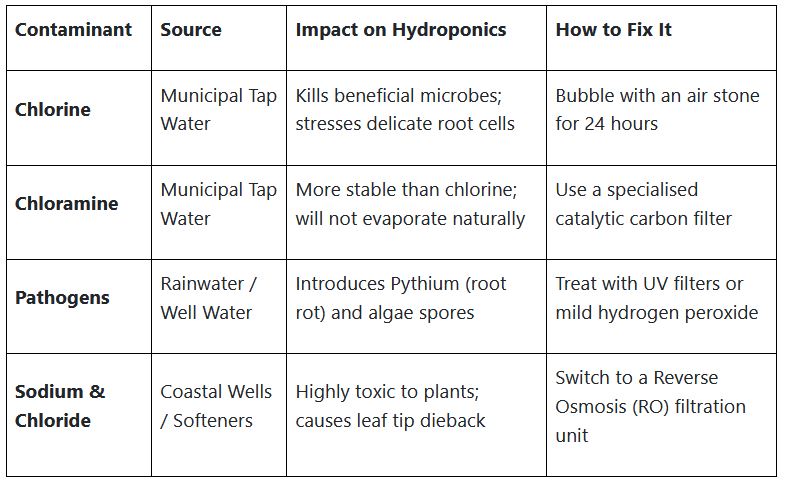
How to use it: If your city uses chlorine, let the water sit in an open bucket for 24 hours with an air stone running to gassify it off. If they use chloramine, aquarium water conditioner or a specialised carbon filter can be used to to remove it.
2. Reverse Osmosis (RO) Water
-
What it is: Pure water that has been forced through a microscopic membrane filter, removing 95–99% of all dissolved minerals, chemicals, and contaminants.
-
The Good: It gives you a perfectly clean slate (0.0 EC). You know exactly what your plants are eating because there are no mystery minerals in the tank.
-
The Bad: RO filters can be expensive to buy, slow to produce water, and wasteful since they create wastewater during the filtration process.
-
How to use it: Because RO water lacks any natural minerals, the hardness must be increased before adding your main nutrients to prevent immediate deficiencies.
3. Rainwater
-
What it is: Soft, natural water collected from rooftops into storage tanks or barrels.
-
The Good: It is completely free and naturally very low in minerals, usually sitting at a near-perfect 0.0 to 0.1 EC.
-
The Bad: It can easily wash bird droppings, mold spores, and roof debris into your system, introducing harmful bacteria or algae directly to your roots.
-
How to use it: Always run rainwater through a fine mesh filter to remove debris, and monitor it closely for root rot or algae blooms.
4. Well or Bore Water (Use with Caution)
-
What it is: Untreated groundwater pumped directly from an underground aquifer.
-
The Good: It is free if you already have the infrastructure on your property.
-
The Bad: It is notoriously "hard." It often has a massive starting EC (sometimes over 1.0) packed with toxic levels of iron, sulphur, or lime, making it incredibly difficult to balance pH.
-
How to use it: Never use well water without getting a laboratory water quality test first. If your starting well water EC is above 0.4, you must mix it with pure water or run it through an RO system before using it for hydroponics.
Importance of Water Quality
Water quality determines whether your starting water is safe for plants or if it will actively lock out nutrients and cause problems.
1. Water Hardness (Total Dissolved Solids)
Hardness measures the amount of dissolved calcium and magnesium already sitting in your water before you add any fertiliser. You can check this by measuring the EC of your raw water straight from the source.
-
Soft Water (Ideal: 0.0 – 0.2 EC): Contains very few minerals. It acts as a blank slate. You have complete control over what your plants eat, though you will need to add some Calcium and Magnesium to slightly increase hardness.
-
Moderate Water (Acceptable: 0.3 – 0.5 EC): Contains a mild amount of background minerals. You can use it safely, but you should slightly reduce your fertiliser dosage to prevent overfeeding.
-
Hard Water (Problematic: 0.6+ EC): Packed with heavy minerals. This leaves very little "room" in the water to add actual plant food without causing nutrient burn. If your raw water is this hard, you should filter it or mix it 50/50 with pure water, or find another suitable water source.
2. Alkalinity (pH Resistance)
Alkalinity is not the same as pH; it is the water's ability to resist changes in pH. It is caused by dissolved carbonates and bicarbonates.
-
High Alkalinity Water: If your source water has high alkalinity, it acts like a chemical sponge that absorbs acid. When you add "pH Down," the pH will drop temporarily, but then bounce right back up a few hours later.
-
The Fix: You will need to use stronger, commercial-grade phosphoric acid adjusters, or use an acid-buffer treatment before mixing your nutrients.
3. Common Water Contaminants