
Choosing between natural sunlight and artificial grow lights depends entirely on your location, setup style, and budget.
While sunlight is completely free, artificial lighting gives growers more control over how your plants grow.
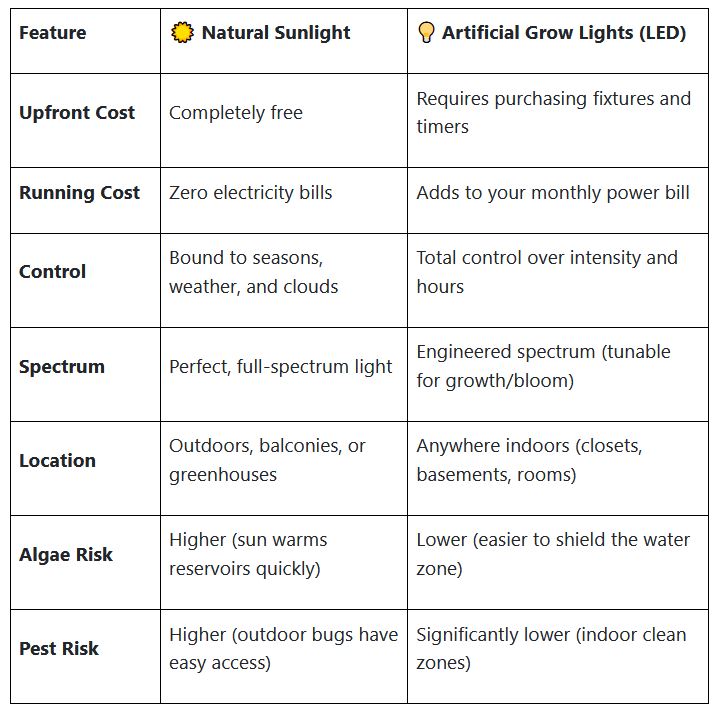
Natural vs. Artificial Lighting Comparison
☀️ Natural Sunlight
Sunlight provides the absolute highest-quality light spectrum possible. It contains a perfect balance of all visible colors, plus natural ultraviolet (UV) and infrared (IR) light that helps plants build strong defenses and robust flavors.
Best Used For
-
Greenhouses: Maximising free energy while using plastic & glass structures to control air temperature.
-
Balconies & Patios: Setting up low-cost DWC buckets or Modular Towers in spots that receive at least 6 hours of direct sun daily.
- Leafy Greens & Herbs: these are commonly grown outdoors and indoors. They require less light but are heat-sensitive so some filtering or partial shade (especially in summer) is important.
The Major Challenges
-
The Heat Trap: Direct sunlight hitting a plastic hydroponic reservoir will rapidly heat the water. Warm water cannot hold enough oxygen, causing immediate root rot. If growing outdoors, you must insulate or bury your reservoir to keep the nutrient cool.
-
Unpredictable Weather: A week of heavy rain or cloudy winter days will instantly stall plant growth.
💡 Artificial Lighting
Modern LED grow lights allow you to completely disregard the seasons. You can grow crisp summer lettuce in the middle of a freezing winter night.
Best Used For
-
Indoor Farms: Creating sealed, sterile environments optimised for high-value crops.
-
Countertop Gardens: Growing fresh salads & herbs right on your benchtop away from windows.
The Major Challenges
-
Ongoing Utility Expenses: Running high-intensity lights for 16 hours a day will add noticeable costs to your electricity bill.
-
Ecosystem Maintenance: Because artificial lights don't provide wind or bees, you have to run oscillating fans to strengthen stems and manually vibrate flowers to pollinate fruiting plants like tomatoes.
Can You Combine Both?
Yes, a hybrid approach can be used, especially indoors. Use free daylight when the sun is shining, but hang a low-wattage grow lights directly above the plants. The grow light can turn on automatically in the late afternoon to extend the day, ensuring the plants get enough light even during short winter days.
Related Articles: Lighting in Hydroponics, Light Requirements of Common Crops.